Yanlai Chen is a Professor of Mathematics at the University of Massachusetts Dartmouth whose research centers on numerical analysis, scientific computing, and scientific machine learning. His work advances high-order discontinuous Galerkin methods, finite element and structure preserving formulations, reduced basis methods, uncertainty quantification, and scientific machine learning notably the GPT-PINN family of physics-informed neural networks. Consistently funded by federal agencies including the NSF and AFOSR, Dr. Chen's research tackles major challenges in linear and nonlinear model order reduction toward fast and reliable numerical methods for partial differential equations and scalable simulations for complex physical systems. He also leads the research enterprise at UMass Dartmouth. See the full list of publications.
Biography

Yanlai Chen received his B.S. degree in Mathematics from the University of Science and Technology of China (USTC) in 2002, his M.S. in Computer Science and Engineering from the Department of Computer Science and Engineering, and his Ph.D. in Mathematics from the School of Mathematics, University of Minnesota, in 2007. Prof. Bernardo Cockburn was his thesis advisor. He then worked as a Postdoctoral Researcher supervised by Prof. Jan Hesthaven and Prof. Yvon Maday at Brown University. Dr. Chen joined the Department of Mathematics, University of Massachusetts Dartmouth, in August 2010 as an Assistant Professor in Mathematics. He was subsequently promoted to Associate Professor with tenure and then to Full Professor.
Dr. Chen's administrative experience includes serving as a (Co-)Graduate Program Director of the Engineering and Applied Science program from September 2020 to June 2024, and as a Co-Director of the Center for Scientific Computing and Data Science Research from January to July 2022. In Spring 2024, Chen was appointed Chief Research Officer of UMass Dartmouth, effective 07/01/2024.
Outside of work and spending time with his family, Dr. Chen enjoys running and serving his communities, including as a member of a school council and a board of trustees. He finished the 2023 Boston Marathon with a time of 3:04:41.
Research Interests
Scientific Machine Learning
- Neural networks, meta-learning (GPT-PINN family)
- Dimension reduction, data mining
- Data visualization
Model Order Reduction
- Reduced basis methods and applications
- Reduced basis element methods
Numerical Methods for PDEs
- Numerical analysis, scientific computing, computational PDEs
- Finite element discontinuous Galerkin methods; adaptive methods
- Mixed finite element and hybridizable DG methods
- Conservation laws, Hamilton–Jacobi-like equations
Uncertainty & Applications
- Uncertainty quantification
- Fractional-order partial differential equations
- Computational electromagnetism
News & Highlights
News page- Sep 28, 2026UMassD New research administration leaders join UMass DartmouthUMass Dartmouth welcomed three new research administration leaders to support researchers, scholars, and staff across the university.
- Sep 2026Paper EGPT-PINN published in Computers & Mathematics with ApplicationsEntropy-regularized generative pre-trained PINNs for parameterized nonlinear conservation laws, with Yajie Ji and Zhenli Xu.
- Jun 2, 2026UMassD Quantum Research Initiative kicks off at UMass DartmouthLaunch of UMass Dartmouth's Quantum Research Initiative with partners from state government, industry, and academia.
- Mar 5, 2026UMassD Catalytic Innovations graduates from UMass Dartmouth's Center for Innovation and EntrepreneurshipRemarks on the CIE as a gateway connecting startups with faculty expertise, student talent, and research infrastructure.
- Spring 2026
- Jan 2026Paper Reduced basis methods for the radiative transfer equation in Journal of Computational PhysicsReduced basis methods for parametric steady-state radiative transfer equation, with Kimberly Matsuda, Yingda Cheng, and Fengyan Li.
- 2026Paper S²GPT-PINN published in Communications in Computational PhysicsReduced basis and hyper reduction-driven double reduction for physics-informed neural networks, with Yajie Ji and Shawn Koohy.
- 2026Paper Graph convolutional autoencoder paper published in CSIAM Transactions on Applied MathematicsDerivative-informed graph convolutional autoencoder with phase classification for the Lifshitz–Petrich model, with Yajie Ji and Zhenli Xu.
- 2026Talk Plenary speaker at NAHOMCon 2026High-order RBM-inspired linear and nonlinear model order reduction approaches for physics-informed machine learning.
- Sep 24, 2025UMassD UMass Dartmouth hosts MassCEC's state roadshow on regional climatetech leadershipRemarks on advancing climate and oceantech research with industry, government, and community partners in Southeastern Massachusetts.
- Jul 1, 2025Grant New AFOSR award on reduced order modeling for kinetic transportTwo-layered reduced order modeling for multiscale kinetic transport problems in rarefied gas dynamics and plasma physics (FA9550-25-1-0181, 2025–2028).
- Summer 2025Group Yajie Ji completes her PhD and starts a postdoc at YaleYajie was a doctoral student at Shanghai Jiao Tong University, jointly advised with Zhenli Xu.
- Spring 2025Service Joined the Board of Directors of the Massachusetts Clean Energy Center (MassCEC) as designee of President Marty MeehanMassCEC welcomed Dr. Yanlai Chen to its Board of Directors.
- Feb 28, 2025UMassD UMass Dartmouth hosts Renewable Energy and Sustainability Roundtable for state officialsShared the university's research vision with state leaders at a roundtable on renewable energy and sustainability.
- Jan 6, 2025Workshop Co-organized the ICERM workshop “Computational Learning for Model Reduction”Topical workshop at ICERM, January 6–10, 2025.
- Oct 10, 2024UMassD Featured in a UMassD faculty commentary on the 2024 Nobel PrizesMentioned among UMass Dartmouth faculty applying machine learning and neural networks in their research.
- Jun 17, 2024Workshop Co-organized NAHOMCon 2024, the North American High Order Methods ConferenceDartmouth College, June 17–19, 2024; local organizer and minisymposium organizer on machine learning algorithms inspired by traditional numerical methods.
- Summer 2024Group Shijin Hou completes her PhD and joins Henan University as an Assistant ProfessorShijin was a doctoral student at USTC, jointly advised with Yinhua Xia.
- May 23, 2024Group UMassD feature story: Shawn Koohy ’24, opportunities in researchShawn's undergraduate research on neural networks, supported by NSF grant DMS-2208277; he went on to doctoral study at UPenn.
- May 14, 2024
- Apr 17, 2024Group Shawn Koohy receives the Outstanding Undergraduate Research awardUMass Dartmouth 2024 Outstanding Scholarship and Mentorship awards.
- Dec 15, 2022Grant AFOSR award: Computationally and Energy Efficient Mixed Precision and Mixed-model Numerical MethodsCo-investigator with PI Sigal Gottlieb on this U.S. Air Force Office of Scientific Research award (FA9550-23-1-0037).
- Aug 1, 2022Grant NSF award DMS-2208277Reduced Basis Enhancements of Neural Networks and Their Application to Quantum Materials Simulation (2022–2026), with co-PI Sigal Gottlieb.
- Nov 2021Media Research highlight: Reduced basis approaches to speed up kinetic transport simulationsMath Institutes highlight (ICERM) on reduced order models for radiative transfer, with Zhichao Peng, Yingda Cheng, and Fengyan Li, from the Spring 2020 ICERM program.
- Sep 8, 2020Grant NSF awards $650,000 S-STEM grant for the ACCOMPLISH programScholarships and a contextualized computing pedagogy to support low-income STEM students at UMass Dartmouth (DUE-2030552).
- Jun 10, 2020Workshop Co-organized Summer@ICERM 2020: Fast Learning Algorithms for Numerical Computation and Data AnalysisSummer undergraduate research program at ICERM, with Akil Narayan and Minah Oh.
- Jan 26, 2020Workshop Co-organized the ICERM semester program “Model and Dimension Reduction in Uncertain and Dynamic Systems”Spring 2020 semester program at ICERM, including the workshop “Algorithms for Dimension and Complexity Reduction.”
- Apr 10, 2019Service Co-organized the Mathematics Department's AfterMath SymposiumThe AfterMath Symposium connects current mathematics students with department alumni.
- Dec 2018Service Guest-edited a Journal of Scientific Computing special issue honoring Bernardo Cockburn's 60th birthdaySpecial issue on discontinuous Galerkin and related methods (vol. 77, no. 3), with Bo Dong and Chi-Wang Shu.
- Jun 29, 2018Talk Invited talk at the ICERM workshop on time-dependent electromagnetic wave problemsComputational Aspects of Time Dependent Electromagnetic Wave Problems in Complex Materials, June 25–29, 2018.
- Summer 2018Group Jiahua Jiang completes her PhD and starts a postdoc at Virginia TechJiahua was co-advised with Akil Narayan and worked on uncertainty quantification and model order reduction.
- Aug 1, 2017Grant NSF award DMS-1719698Rigorous Development of an Efficient Reduced Collocation Approach for High-Dimensional Parametric PDEs (2017–2022), with co-PI Sigal Gottlieb.
- Jun 29, 2017Workshop Co-organized the IMA workshop “Recent Advances and Challenges in Discontinuous Galerkin Methods and Related Approaches”University of Minnesota, June 29–July 1, 2017, supported by NSF award DMS-1720825 (with Bo Dong).
- May 27, 2017Group Christopher Bresten earns his PhD in Engineering and Applied ScienceChris was co-advised with Sigal Gottlieb and worked on model order reduction for nonlinear and nonaffine problems.
- 2017Group Rebecca Pereira (BS 2017) continues to the PhD program in the groupRebecca joined the EAS-CSE PhD program to develop discontinuous Galerkin methods with Bo Dong.
- Apr 26, 2016Service Designed and coordinated the Mathematics Department's inaugural AfterMath SymposiumA program connecting graduating seniors with department alumni.
- Jun 2014Talk Minisymposium talk at ICOSAHOM 2014, Salt Lake CityInternational Conference on Spectral and High Order Methods, June 23–27, 2014.
- Apr 17, 2014Award Andrew Davey receives a Ben L. Fryrear Fellowship to the Colorado School of MinesAndrew worked in the group from 2012 to 2014 on successive constraint methods in the collocation framework.
- Jul 23, 2012Grant NSF award DMS-1216928Developing Reduced Basis Methods for Galerkin and Collocation Framework (2012–2016).
- Jun 26, 2012Talk Talk at the BIRS workshop on fast PDE algorithms, BanffCertified fast algorithms for electromagnetic problems: reduced basis methods.
Research Supported By
- AFOSR (FA9550-25-1-0181)
- National Science Foundation (DMS-2208277, DMS-1719698, DMS-1720825, DMS-1216928)
- National Science Foundation (DUE-2030552), the ACCOMPLISH S-STEM program
- UMass Dartmouth MUST program, established by Dr. Ramprasad Balasubramanian, sponsored by ONR (2020–2023), Co-PI / Team member
- UMass President's Office Science and Technology Initiative Funds (2013–2014)
- UMassD Multidisciplinary Seed Funding Program (Spring 2014)
- UMass Dartmouth Chancellor's Research Fund and Joseph P. Healey Endowment Grants (2011–2012)
- Startup fund from the College of Arts and Sciences (2010–2013)
Related Profiles




Major Related Links
- CV (PDF)
- Ph.D. in Engineering and Applied Science (EAS) with Computational Science and Engineering (CSE) option
- Graduate Studies and Admissions at UMassD
- Current Math-based EAS-PhD students
- Math-based EAS-PhD alumni
- Computational Science Seminar at UMassD
Helpful Advice and Tips
- Advice for and expectations from new and current students: Modest advice from Dorsa Amir (web version, PDF); advice from Dr. Jan Hesthaven (web version, PDF)
- A detailed checklist for paper writing, prepared by Dr. Zheng Zhang from UCSB (web version, PDF)
Published and Submitted Articles
Full list on Google Scholar Publications page BibTeX- Reduced basis methods for parametric steady-state radiative transfer equationJournal of Computational Physics, Vol. 548, pp. 114597 (2026)The radiative transfer equation (RTE) is a fundamental mathematical model to describe physical phenomena involving the propagation of radiation and its interactions with the host medium, and it arises in many applications. Deterministic methods can produce accurate solutions without any statistical noise, yet often at a price of expensive computational costs originating from the intrinsic high dimensionality of the model. This is more prominent in multi-query tasks, e.g., inverse problems and optimal design, when the RTE needs to be solved repeatedly. This motivates the developments of dimensionality and model order reduction techniques for such transport models. With this work, we present the first systematic investigation of projection-based reduced order models (ROMs) following the reduced basis method (RBM) framework to simulate the parametric steady-state RTE with isotropic scattering and one energy group. The use of RBM compared to standard proper orthogonal decomposition (POD) is well motivated, especially considering that a large number of degrees of freedom is needed by full order models to solve high dimensional transport models like RTE. Four ROMs are designed, with each defining a nested family of reduced surrogate solvers of different resolution/fidelity. They are based on either a Galerkin or least-squares Petrov-Galerkin projection and utilize either an L1 or residual-based importance/error indicator. Two of the proposed ROMs are certified in the setting when the absorption cross section is positively bounded below uniformly. One technical focus and contribution lie in the proposed implementation strategies under the affine assumption of the parameter dependence of the model. These well-crafted broadly applicable strategies not only ensure the efficiency and accuracy of the offline training stage and the online prediction of reduced surrogate solvers, they also take into account the conditioning of the reduced systems as well as the stagnation-free residual evaluation for numerical robustness. Computational complexities are derived for both the offline training and online prediction stages of the proposed model order reduction strategies, and they are demonstrated numerically along with the accuracy and robustness of the reduced surrogate solvers. Numerically we observe four to six orders of magnitude speedup of our ROMs compared to full order models for some 2D2v examples.
- Derivative-informed Graph Convolutional Autoencoder with Phase Classification for the Lifshitz-Petrich ModelCSIAM Transactions on Applied Mathematics (2026)
- S$^2$GPT-PINN: Reduced basis and hyper reduction-driven double reduction for Physics-Informed Neural NetworksCommunications in Computational Physics, Vol. 40, No. 4, pp. 1293–1316 (2026)
- EGPT-PINN: Entropy-regularized generative pre-trained physics informed neural networks for parameterized nonlinear conservation lawsComputers & Mathematics with Applications, Vol. 222, pp. 223–243 (2026)
- Nonlinear Model Order Reduction on Quadratic Manifolds via Greedy Algorithms with Dimension-Dependent Regularization PreprintSubmitted (2026)
- High-order Conservative Discontinuous Galerkin Methods via Implicit Penalization for the Generalized Korteweg–de Vries Equation and the Hirota–Satsuma KdV System PreprintSubmitted (2026)
- ReBaNO: Reduced Basis Neural Operator Mitigating Generalization Gaps and Achieving Discretization Invariance PreprintarXiv preprint arXiv:2509.09611 (2025)
- AAROC: Reduced Over-Collocation Method With Adaptive Time Partitioning and Adaptive Enrichment for Parametric Time-Dependent EquationsNumerical Methods for Partial Differential Equations, Vol. 41, No. 5, pp. e70031 (2025)ABSTRACT Nonlinear and nonaffine terms in parametric partial differential equations can potentially lead to a computational cost of a reduced-order model (ROM) that is comparable to the cost of the original full-order model (FOM). To address this, the Reduced Residual Reduced Over-Collocation method (R2-ROC) is developed as a hyper-reduction method within the framework of the reduced basis method in the collocation setting. R2-ROC greedily selects two sets of reduced collocation points based on the (generalized) empirical interpolation method for both solution snapshots and residuals, thereby avoiding the computational inefficiency. The vanilla R2-ROC method can face instability when applied to parametric fluid dynamic problems. To address this, an adaptive enrichment strategy has been proposed to stabilize the ROC method. However, this strategy can involve an excessive number of reduced collocation points, thereby negatively impacting online efficiency. To ensure both efficiency and accuracy, we propose an adaptive time partitioning and adaptive enrichment strategy-based ROC method (AAROC). The adaptive time partitioning dynamically captures the low-rank structure, necessitating fewer reduced collocation points being sampled in each time segment. Numerical experiments on the parametric viscous Burgers' equation and lid-driven cavity problems demonstrate the efficiency, enhanced stability, and accuracy of the proposed AAROC method.
- A reduced basis warm-start iterative solver for the parameterized linear systemsBeijing Journal of Pure and Applied Mathematics, Vol. 2, No. 1, pp. 123–146 (2025)
- Greedy Rational Approximation for Frequency-Domain Model Reduction of Parametric LTI Systems PreprintarXiv preprint arXiv:2512.23814 (2025)
- GPT-PINN: Generative Pre-Trained Physics-Informed Neural Networks toward non-intrusive Meta-learning of parametric PDEsFinite Elements in Analysis and Design, Vol. 228, pp. 104047 (2024)Physics-Informed Neural Network (PINN) has proven itself a powerful tool to obtain the numerical solutions of nonlinear partial differential equations (PDEs) leveraging the expressivity of deep neural networks and the computing power of modern heterogeneous hardware. However, its training is still time-consuming, especially in the multi-query and real-time simulation settings, and its parameterization often overly excessive. In this paper, we propose the Generative Pre-Trained PINN (GPT-PINN) to mitigate both challenges in the setting of parametric PDEs. GPT-PINN represents a brand-new meta-learning paradigm for parametric systems. As a network of networks, its outer-/meta-network is hyper-reduced with only one hidden layer having significantly reduced number of neurons. Moreover, its activation function at each hidden neuron is a (full) PINN pre-trained at a judiciously selected system configuration. The meta-network adaptively “learns” the parametric dependence of the system and “grows” this hidden layer one neuron at a time. In the end, by encompassing a very small number of networks trained at this set of adaptively-selected parameter values, the meta-network is capable of generating surrogate solutions for the parametric system across the entire parameter domain accurately and efficiently.
- Design of Experiments via Multi-Fidelity Surrogates and Statistical Sensitivity MeasuresJournal of Machine Learning for Modeling and Computing, Vol. 5, No. 4, pp. 95–121 (2024)
- TGPT-PINN: Nonlinear model reduction with transformed GPT-PINNsComputer Methods in Applied Mechanics and Engineering, Vol. 430, pp. 117198 (2024)
- MCMS-RBM: Multicomponent Multistate Reduced Basis Method Toward Rapid Generation of Phase Diagrams for the Lifshitz–Petrich ModelSIAM Journal on Scientific Computing, Vol. 46, No. 6, pp. B785-B805 (2024)Abstract. Due to quasicrystals having long-range orientational order but without translational symmetry, traditional numerical methods usually suffer when applied as is. In the past decade, the projection method has emerged as a prominent solver for quasiperiodic problems. Transforming them into higher-dimensional but periodic ones, the projection method facilitates the application of the fast Fourier transform. However, the computational complexity inevitably becomes high, which significantly impedes, e.g., the generation of the phase diagram since a high-fidelity simulation of a problem whose dimension is doubled must be performed for numerous times. To address the computational challenge of quasiperiodic problems based on the projection method, this paper proposes a multicomponent multistate reduced basis method (MCMS-RBM). Featuring multiple components with each providing reduction functionality for one branch of the problem induced by one part of the parameter domain, the MCMS-RBM does not resort to the parameter domain configurations (e.g., phase diagrams) a priori. It enriches each component in a greedy fashion via a phase transition guided exploration of the multiple states inherent to the problem. Adopting the empirical interpolation method, the resulting online-efficient method vastly accelerates the generation of a delicate phase diagram to a matter of minutes for a parametrized two-turn-four dimensional Lifshitz–Petrich model with two length scales. Moreover, it furnishes surrogate and equally accurate field variables anywhere in the parameter domain.
- A Micro-Macro Decomposed Reduced Basis Method for the Time-Dependent Radiative Transfer EquationMultiscale Modeling & Simulation, Vol. 22, No. 1, pp. 639–666 (2024)
- A New Conservative Discontinuous Galerkin Method via Implicit Penalization for the Generalized Korteweg–de Vries EquationSIAM Journal on Numerical Analysis, Vol. 60, No. 6, pp. 3078-3098 (2022)Abstract. We design, analyze, and implement a new conservative discontinuous Galerkin (DG) method for the simulation of solitary wave solutions to the generalized Korteweg–de Vries (KdV) equation. The key feature of our method is the conservation, at the numerical level, of the mass, energy, and Hamiltonian that are conserved by exact solutions of all KdV equations. To our knowledge, this is the first DG method that conserves all these three quantities, a property critical for the accurate long-time evolution of solitary waves. To achieve the desired conservation properties, our novel idea is to introduce two stabilization parameters in the numerical fluxes as new unknowns, which then allow us to enforce the conservation of energy and Hamiltonian in the formulation of the numerical scheme. We prove the conservation properties of the scheme which are corroborated by numerical tests. This idea of achieving conservation properties by implicitly defining penalization parameters, which are traditionally specified a priori, can serve as a framework for designing physics-preserving numerical methods for other types of problems.
- Fast $L^2$ Optimal Mass Transport via Reduced Basis Methods for the Monge–Ampère EquationSIAM Journal on Scientific Computing, Vol. 44, No. 6, pp. A3536-A3559 (2022)Repeatedly solving the parameterized optimal mass transport (pOMT) problem is a frequent task in applications such as image registration and adaptive grid generation. It is thus critical to develop a highly efficient reduced solver that is equally accurate as the full order model. In this paper, we propose such a machine learning–like method for pOMT by adapting a new reduced basis (RB) technique specifically designed for nonlinear equations, the reduced residual reduced over-collocation (R2-ROC) approach, to the parameterized Monge–Ampère equation. It builds on top of a narrow-stencil finite difference method (FDM), a so-called truth solver, which we propose in this paper for the Monge–Ampère equation with the transport boundary. Together with the R2-ROC approach, it allows us to handle the strong and unique nonlinearity pertaining to the Monge–Ampère equation achieving online efficiency without resorting to any direct approximation of the nonlinearity. Several challenging numerical tests demonstrate the accuracy and high efficiency of our reduced solver for solving the parameterized Monge–Ampère equation, effectively transporting the nontrivial boundaries.
- A hyper-reduced MAC scheme for the parametric Stokes and Navier-Stokes equationsJournal of Computational Physics, Vol. 466, pp. 111412 (2022)The need for accelerating the repeated solving of certain parametrized systems motivates the development of more efficient reduced order methods. The classical reduced basis method is popular due to an offline-online decomposition and a mathematically rigorous a posterior error estimator which guides a greedy algorithm offline. For nonlinear and nonaffine problems, hyper reduction techniques have been introduced to make this decomposition efficient. However, they may be tricky to implement and often degrade the offline and online computational efficiency. To avoid this degradation, reduced residual reduced over-collocation (R2-ROC) was invented. It integrates the empirical interpolation techniques on the solution snapshots and the well-chosen residuals, the collocation philosophy, and the simplicity of evaluating the hyper-reduced well-chosen residuals. In this paper, we introduce an adaptive enrichment strategy for R2-ROC rendering it capable of handling parametric fluid flow problems. Built on top of an underlying Marker and Cell (MAC) scheme, a novel hyper-reduced MAC scheme is therefore presented and tested on lid-driven cavity and flow past a backward-facing step problems demonstrating its high efficiency, stability and accuracy.
- A reduced basis method for radiative transfer equationJournal of Scientific Computing, Vol. 91, No. 5, pp. 24 (2022)
- Model reduction for fractional elliptic problems using Kato's formulaMathematical Control and Related Fields, Vol. 12, No. 1, pp. 115-146 (2022)We propose a novel numerical algorithm utilizing model reduction for computing solutions to stationary partial differential equations involving the spectral fractional Laplacian. Our approach utilizes a known characterization of the solution in terms of an integral of solutions to local (classical) elliptic problems. We reformulate this integral into an expression whose continuous and discrete formulations are stable; the discrete formulations are stable independent of all discretization parameters. We subsequently apply the reduced basis method to accomplish model order reduction for the integrand. Our choice of quadrature in discretization of the integral is a global Gaussian quadrature rule that we observe is more efficient than previously proposed quadrature rules. Finally, the model reduction approach enables one to compute solutions to multi-query fractional Laplace problems with orders of magnitude less cost than a traditional solver.
- L1-based reduced over collocation and hyper reduction for steady state and time-dependent nonlinear equationsJ. Sci. Compt., Vol. 87, pp. 10 (2021)
- An EIM-degradation free reduced basis method via over collocation and residual hyper reduction-based error estimationJournal of Computational Physics, Vol. 444, pp. 110545 (2021)The need for multiple interactive, real-time simulations using different parameter values has driven the design of fast numerical algorithms with certifiable accuracies. The reduced basis method (RBM) presents itself as such an option. RBM features a mathematically rigorous error estimator which drives the construction of a low-dimensional subspace. A surrogate solution is then sought in this low-dimensional space approximating the parameter-induced high fidelity solution manifold. However when the system is nonlinear or its parameter dependence nonaffine, this efficiency gain degrades tremendously, an inherent drawback of the application of the empirical interpolation method (EIM). In this paper, we augment and extend the EIM approach as a direct solver, as opposed to an assistant, for solving nonlinear partial differential equations on the reduced level. The resulting method, called Reduced Over-Collocation method (ROC), is stable and capable of avoiding the efficiency degradation. Two critical ingredients of the scheme are collocation at about twice as many locations as the number of basis elements for the reduced approximation space, and an efficient error indicator for the strategic building of the reduced solution space. The latter, the main contribution of this paper, results from an adaptive hyper reduction of the residuals for the reduced solution. Together, these two ingredients render the proposed R2-ROC scheme both offline- and online-efficient. A distinctive feature is that the efficiency degradation appearing in traditional RBM approaches that utilize EIM for nonlinear and nonaffine problems is circumvented, both in the offline and online stages. Numerical tests on different families of time-dependent and steady-state nonlinear problems demonstrate the high efficiency and accuracy of our R2-ROC and its superior stability performance.
- Adaptive greedy algorithms based on parameter-domain decomposition and reconstruction for the reduced basis methodInternational Journal for Numerical Methods in Engineering, Vol. 121, No. 23, pp. 5426-5445 (2020)Abstract The reduced basis method (RBM) empowers repeated and rapid evaluation of parametrized partial differential equations through an offline–online decomposition, a.k.a. a learning-execution process. A key feature of the method is a greedy algorithm repeatedly scanning the training set, a fine discretization of the parameter domain, to identify the next dimension of the parameter-induced solution manifold along which we expand the surrogate solution space. Although successfully applied to problems with fairly high parametric dimensions, the challenge is that this scanning cost dominates the offline cost due to it being proportional to the cardinality of the training set which is exponential with respect to the parameter dimension. In this work, we review three recent attempts in effectively delaying this curse of dimensionality, and propose two new hybrid strategies through successive refinement and multilevel maximization of the error estimate over the training set. All five offline-enhanced methods and the original greedy algorithm are tested and compared on two types of problems: the thermal block problem and the geometrically parameterized Helmholtz problem.
- A robust error estimator and a residual-free error indicator for reduced basis methodsComputers & Mathematics with Applications, Vol. 77, pp. 1963–1979 (2019)
- Certified Offline-Free Reduced Basis (COFRB) Methods for Stochastic Differential Equations Driven by Arbitrary Types of NoiseJournal of Scientific Computing (2019)In this paper, we propose, analyze, and implement a new reduced basis method (RBM) tailored for the linear (ordinary and partial) differential equations driven by arbitrary (i.e. not necessarily Gaussian) types of noise. There are four main ingredients of our algorithm. First, we propose a new space-time-like treatment of time in the numerical schemes for ODEs and PDEs. The second ingredient is an accurate yet efficient compression technique for the spatial component of the space-time snapshots that the RBM is adopting as bases. The third ingredient is a non-conventional ``parameterization'' of a non-parametric problem. The last is a RBM that is free of any dedicated offline procedure yet is still efficient online. The numerical experiments verify the effectiveness and robustness of our algorithms for both types of differential equations.
- Certified reduced basis methods for fractional Laplace equations via extensionSiam J. Sci. Comput., Vol. 41, No. 6, pp. A3552-A3575 (2019)
- A Reduced Basis Method for the Nonlinear Poisson-Boltzmann EquationAdvances in Applied Mathematics and Mechanics, Vol. 11, No. 5, pp. 1200–1218 (2019)<p>In numerical simulations of many charged systems at the micro/nano scale, a common theme is the repeated resolution of the Poisson-Boltzmann equation. This task proves challenging, if not entirely infeasible, largely due to the nonlinearity of the equation and the high dimensionality of the physical and parametric domains with the latter emulating the system configuration. In this paper, we for the first time adapt a mathematically rigorous and computationally efficient model order reduction paradigm, the so-called reduced basis method (RBM), to mitigate this challenge. We adopt a finite difference method as the mandatory underlying scheme to produce the high-fidelity numerical solutions of the Poisson-Boltzmann equation upon which the fast RBM algorithm is built and its performance is measured against. Numerical tests presented in this paper demonstrate the high efficiency and accuracy of the fast algorithm, the reliability of its error estimation, as well as its capability in effectively capturing the boundary layer.</p>
- L1-ROC and R2-ROC: L1- and R2-based Reduced Over-Collocation methods for parametrized nonlinear partial differential equations PreprintarXiv:1906.07349 (2019)
- Optimally convergent hybridizable discontinuous Galerkin method for fifth-order Korteweg-de Vries type equationsESAIM: M2AN, Vol. 52, No. 6, pp. 2283-2306 (2018)
- Reduced-basis method for the iterative solution of parametrized symmetric positive-definite linear systems PreprintarXiv:1804.06363 (2018)
- A Foreword to the Special Issue in Honor of Professor Bernardo Cockburn on His 60th Birthday: A Life Time of Discontinuous SchemingsJournal of Scientific Computing, Vol. 77, No. 3, pp. 1303–1309 (2018)We present this special issue of the Journal of Scientific Computing to celebrate Bernardo Cockburn’s sixtieth birthday. The theme of this issue is discontinuous Galerkin methods, a hallmark of Bernardo’s distinguished professional career. This foreword provides an informal but rigorous account of what enabled Bernardo’s achievements, based on the concluding presentation he gave at the the IMA workshop “Recent Advances and Challenges in Discontinuous Galerkin Methods and Related Approaches” on July 1, 2017 which was widely deemed as the best lecture of his career so far.
- Offline-Enhanced reduced basis method through adaptive construction of the surrogate training set.J. Sci. Comput., Vol. 73, No. 2, pp. 853–875 (2017)
- A Certified Natural-Norm Successive Constraint Method for Parametric Inf-Sup Lower BoundsApplied Numer. Math., Vol. 99, pp. 98–108 (2016)
- Superconvergent HDG methods for linear, stationary, third-order equations in one-space dimensionMath. Comp., Vol. 85, pp. 2715-2742 (2016)
- A new discontinuous Galerkin method, conserving the discrete H2-norm, for third-order linear equations in one space dimensionIMA J. Num. Anal., Vol. 36, No. 4, pp. 1570-1598 (2016)
- A reduced radial basis function method for partial differential equations on irregular domainsJ. Sci. Comput., Vol. 66, No. 1, pp. 67-90 (2016)
- A goal-oriented RBM-Accelerated generalized polynomial chaos algorithmSIAM/ASA JUQ, Vol. 4, No. 1, pp. 1398–1420 (2016)
- Reduced Basis Decomposition: a Certified and Fast Lossy Data Compression AlgorithmComputers and Mathematics with Applications, Vol. 70, pp. 2566–2574 (2015)
- Using Visualization and Analysis with Efficient Dimension Reduction Techniques to Determine Underlying Factors in Hospital Inpatient Procedure Costs2015 IEEE Conference on Visual Analytics Science and Technology (VAST), Vol. 00, pp. 205-206 (2015)
- Analysis of variable-degree HDG methods for Convection-Diffusion equations. Part II: Semimatching nonconforming meshesMath. Comp., Vol. 83, No. 285, pp. 87–111 (2014)
- Parametric Analytical Preconditioning and its Applications to the Reduced Collocation Methods.C. R. Acad. Sci. Paris, Ser. I, Vol. 352, pp. 661-666 (2014)
- Reduced Collocation Methods: Reduced Basis Methods in the Collocation Framework.J. Sci. Comput., Vol. 55, No. 3, pp. 718–737 (2013)
- Transformation of a Mathematics Department's Teaching and Research Through a Focus on Computational ScienceJOCSE, Vol. 4, No. 1, pp. 24-29 (2013)
- Analysis of variable-degree HDG methods for convection-diffusion equations. Part I: General nonconforming meshesIMA J. Numer. Anal., Vol. 32, No. 4, pp. 1267–1293 (2012)
- Certified Reduced Basis Method for Electromagnetic Scattering and Radar Cross Section EstimationCMAME, Vol. 233, pp. 92–108 (2012)
- A Seamless Reduced Basis Element Methods for 2D Maxwell's Problem: An Introduction ProceedingsSpectral and High Order Methods for Partial Differential Equations, Lecture Notes in Computational Science and Engineering, No. 76, pp. 141–152 (2011)
- Certified reduced basis methods and output bounds for the harmonic Maxwell's equationsSiam J. Sci. Comput., Vol. 32, No. 2, pp. 970–996 (2010)
- A Natural-Norm Successive Constraint Method for Inf-Sup Lower BoundsCMAME, Vol. 199, pp. 1963–1975 (2010)
- Improved Successive Constraint Method Based A Posteriori Error Estimate for Reduced Basis Approximation of 2D Maxwell's ProblemM2AN, Vol. 43, pp. 1099–1116 (2009)
- A Monotonic Evaluation of Lower Bounds for Inf-Sup Stability Constants in the Frame of Reduced Basis ApproximationsC. R. Acad. Sci. Paris, Ser. I, Vol. 346, pp. 1295–1300 (2008)
- An adaptive high order discontinuous Galerkin method with error control for the Hamilton-Jacobi Equations. Part I: The one-dimensional steady state caseJ. Comput. Phys., Vol. 226, No. 1, pp. 1027–1058 (2007)
Some Journals in My Field





Postdoctoral Researchers

Dr. Preskella Mrad
Preskella is a Postdoctoral Researcher who joined in Spring 2026.
Current Graduate Students

David Gillcrist
David is a PhD student who started in Fall 2020, jointly advised with Mazdak Tootkaboni from Civil Engineering.

Haolan Zheng
Haolan is a PhD student who started in Fall 2023.

Muhammad Shan Tariq
Shan is a PhD student who started in Fall 2024, jointly advised with Bo Dong from Mathematics.

Hai-Shuo Shu
Hai-Shuo is a PhD student who started in Fall 2024, jointly advised with Zheng Chen from Mathematics.
Graduate Student Alumni (Mathematics Genealogy Project)

Yajie Ji
Yajie was a doctoral student at Shanghai Jiao Tong University, jointly advised with Zhenli Xu.
Upon graduation in Summer 2025, Yajie started working as a Postdoc at Yale.

Shijin Hou
Shijin was a doctoral student at the University of Science and Technology of China, jointly advised with Yinhua Xia.
Upon graduation in Summer 2024, Shijin started working as an Assistant Professor at Henan University.

Rebecca Pereira
Rebecca started her PhD in Fall 2017. In Summer 2017, she worked on fast algorithms for geometric engineering design under uncertainty, jointly with Mazdak Tootkaboni from Civil Engineering. In Summer 2018, she started a project on (hybridizable) discontinuous Galerkin methods, jointly with Bo Dong from Mathematics.
Upon graduation in Spring 2023, Rebecca started working at a federal agency.

Richard Bellizzi
With Alfa Heryudono as the main advisor, Richard was a part-time PhD student while working at Nye Lubricants.
Richard worked on building mathematical models and implementing machine learning algorithms for lubricant manufacturing.
Since graduating in Spring 2023, Richard has continued his career in the lubricant industry.

Lijie Ji
Lijie was a doctoral student at Shanghai Jiao Tong University, jointly advised with Zhenli Xu. She worked on the reduced basis method and the reduced over-collocation method beginning in early 2018, and visited the CHEN Lab from September 2019 to September 2020.
Upon graduation in 2021, Lijie became a Wu Wen-Tsun Assistant Professor at Shanghai Jiao Tong University.

Jiahua Jiang
Co-advised with Akil Narayan and also working under the guidance of Bo Dong, Jiahua focused on uncertainty quantification and model order reduction. She started her doctoral study in Fall 2013 and graduated in Summer 2018.
Jiahua's research was supported by a fellowship from the Center for Scientific Computing and Visualization Research at UMassD, an NSF grant, and a UMassD Multidisciplinary Seed Fund (MSF).
Jiahua worked as a postdoc at Virginia Tech upon graduation in 2018, and then became an assistant professor at the University of Birmingham.

Christopher Bresten
Co-advised with Sigal Gottlieb, Chris was a PhD student working on model order reduction for nonlinear and nonaffine problems. He started this project in Fall 2012 and graduated in 2017.
Chris's research was supported in part by an NSF grant.
After graduating, Chris went on to a postdoc position in Korea.
Undergraduate Student Alumni

Shawn Koohy
Supported by an NSF grant, Shawn was a sophomore when he started exploring neural networks in Spring 2022. He graduated in 2024 and started pursuing his doctoral degree at UPenn.

Chase Parenteau
Chase was an honors student admitted to the university in 2018. Starting in Spring 2019, he worked on mathematical models and machine learning algorithms for sports analytics.

Jonathan Curtis
Starting in Summer 2017, Jonathan analyzed and implemented a GPU-accelerated reduced basis method.
Jonathan's research was supported by the Department of Mathematics, UMassD.

Ian Camerlin
Starting in Summer 2014, Ian implemented GPU algorithms.
Ian's research was supported by an NSF grant. Ian graduated in 2016 and took a job in industry.

Peter Takahashi
Peter started in Summer 2014, working on reduced basis type model reduction techniques for data science.
Peter's research was partially supported by the President's S&T grant. Peter chose to pursue his interests in computer science starting in Fall 2015. He graduated in 2017 and went on to graduate school at Yale University.

Jacob Sousa
Advised by and working with Alfa Heryudono before Spring 2014, Jacob worked with me on modeling and its reduction for a computational biology project in Spring 2014. He then went on to the EAS PhD program at the University of Massachusetts Dartmouth.
Jacob's research was supported by the UMassD Multidisciplinary Seed Funding (MSF) program.

Andrew Davey
Andrew mainly focused on implementing successive constraint methods in the collocation framework and devising appropriate variants. He started in Summer 2012 and left in Summer 2014, having been awarded a Ben L. Fryrear Fellowship in Computational Science to pursue his PhD at the Colorado School of Mines.
Andrew's research was mainly supported by an NSF grant and also by UMassD's Multidisciplinary Seed Funding (MSF) program.
Below is a brief Office of Undergraduate Research (OUR) interview of Andrew talking about his experience at UMassD.

Rushendra Kumar
Rushendra was a summer intern in 2012, coming from the Indian Institute of Technology Bhubaneswar. He later joined Springforth Capital Advisors in the Bhubaneswar area of India.
Dedication to Teaching and Advising
Thanks to the National Science Foundation, via grant DUE-2030552, we have established the ACCOMPLISH program, whose mission is to provide multi-faceted financial and social support and a contextualized, computing-centered educational framework for eligible STEM students, to propel them into the nation's high-quality STEM workforce.
On this page
- My schedule
- Courses I am currently teaching
- Sample videos of my in-class lectures
- Resources for deep learning
My Schedule
Current Teaching
See UMassD myCourses for the class webpages.
Sample Videos of In-Class Lectures (Fall 2019)
Resources for Deep Learning
Books and survey papers
- Ian Goodfellow, Yoshua Bengio, and Aaron Courville, Deep Learning (textbook, free online).
- Simon J. D. Prince, Understanding Deep Learning (2023, free online).
- Catherine F. Higham and Desmond J. Higham, Deep Learning: An Introduction for Applied Mathematicians.
- Gabriel Peyré and Marco Cuturi, Computational Optimal Transport.
- Steven L. Brunton and J. Nathan Kutz, Data-Driven Science and Engineering (book and lecture videos).
Scientific machine learning
- M. Raissi, P. Perdikaris, and G. E. Karniadakis, Physics-informed neural networks (J. Comput. Phys., 2019).
- G. E. Karniadakis et al., Physics-informed machine learning (Nature Reviews Physics, 2021).
- Neural operators: DeepONet and the Fourier Neural Operator.
- Weinan E and Bing Yu, The Deep Ritz Method.
- ReLU DNN and Linear FEM, PDE-Net, PDE-Net 2.0.
- Adam Oberman's ICERM presentation on PDEs and DNNs: slides and video.
- Optimal transport and GANs: an easy-to-follow summary of the Wasserstein GAN, and Vincent Herrmann's blog entry on the Kantorovich–Rubinstein duality.
Courses
- Stanford CS231n: deep learning for computer vision.
- Stanford CS224n: natural language processing with deep learning.
- Stanford CS229: machine learning (Andrew Ng et al.).
- fast.ai: Practical Deep Learning for Coders.
Tools, libraries, and data
- Deep learning frameworks: PyTorch, JAX, Keras.
- PINN library: DeepXDE.
- Probabilistic programming: Pyro.
- Models and datasets: Hugging Face; Google Dataset Search.
- A collection of deep learning architectures, models, and tips (Sebastian Raschka).
- Visualization: TensorFlow Embedding Projector; Adam Harley's interactive CNN visualization.
Software Packages
GPT-PINN (GitHub)
Paper: GPT-PINN: Generative Pre-Trained Physics-Informed Neural Networks toward non-intrusive Meta-learning of parametric PDEs (Finite Elements in Analysis and Design, 2024); also on ResearchGate.

An NA G-ROMs talk given on 5/16/2023 on GPT-PINN:
TGPT-PINN (GitHub)
Paper: TGPT-PINN: Nonlinear model reduction with transformed GPT-PINNs (Computer Methods in Applied Mechanics and Engineering, 2024); also on ResearchGate.
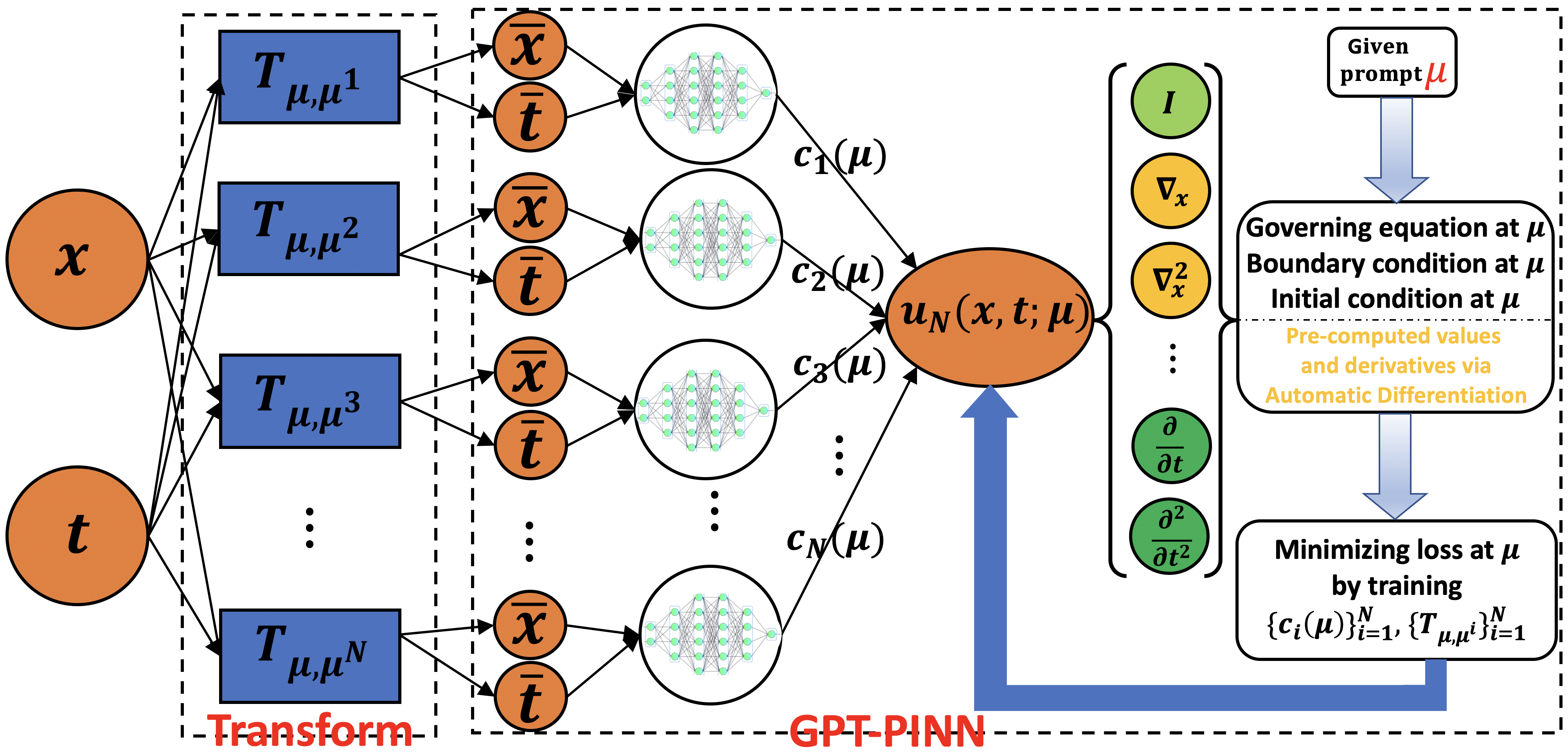
The DDPS Webinar given at Lawrence Livermore National Laboratory on 4/5/2024 on GPT-PINN and TGPT-PINN:
Reduced Basis Decomposition (RBD)
A user-friendly page with the Matlab test code using RBD for data compression (see the paper Reduced Basis Decomposition: a Certified and Fast Lossy Data Compression Algorithm): Reduced Basis Decomposition page.
- Sample application: lossy image compression and greedy face recognition, on the FR_RBD page.
Research Talks (Video)
- Certified fast algorithms for electromagnetic problems: reduced basis methods — Banff International Research Station, 6/26/2012.
- A talk on the reduced basis method — ICERM, 6/29/2018.
- Introductory talks at ICERM, Spring 2020: Part I, Part II.
Misc. Slides
Quick Links
Professional societies
- SIAM — Society for Industrial and Applied Mathematics
- AMS — American Mathematical Society
- MAA — Mathematical Association of America
Institutes and funding
Literature and references
- arXiv
- MathSciNet · zbMATH Open · Google Scholar
- The Mathematics Genealogy Project
- OEIS — On-Line Encyclopedia of Integer Sequences
- MacTutor History of Mathematics
- Netlib — mathematical software
Personal & Community
- Yanlai Chen as a member of the Sharon Chinese Association
- My marathon results (MarathonGuide.com)
Contact Information


Office: Foster 008
Office of Research and Innovation
University of Massachusetts Dartmouth
285 Old Westport Road
North Dartmouth, MA 02747
Phone: 1-508-999-8827
Fax: 1-508-999-8868
E-mail: first.last@umassd.edu